


Latest Cross Border Trade Updates
Latest Cross Border Trade Updates
Delays at the Border – Tips to Avoid
IPAFFS & CDS (customs) documentary processing is complex, and often delays are experienced at the border which can be resolved by knowing what actions you and/or your agent can take to mitigate some of the most common causes of processing delays with consignments held at the border. HTA have prepared the following tips to help you navigate this.
1. Multiple CHEDs under the same MRN.
Where a load or container consists of a mixed load or groupage, there is an increased risk that the SPS hold on the customs declaration will not be lifted if one or more of the consignments in the load requires an inspection.
Example: an agent or importer has correctly submitted 3 separate CHED import notifications in IPAFFS for 3 consignments in a vehicle’s load. All 3 are correctly recorded on the customs declaration in CDS. Checking on IPAFFS, two of the consignments have been cleared as valid but one is still undergoing documentary checks and has not yet been cleared. An SPS hold is showing on the customs declaration in CDS. Once all 3 CHEDS are cleared as valid by the Port Health Authority / APHA, the SPS hold is removed from the customs declaration and HMRC/Border Force can release the load if no further customs checks are required.
Action to take: Traders and their agents are asked to check the status of their consignments via IPAFFS and CDS and where necessary discuss options to minimise delays with the Port Health Authority/Local Authority/Animal & Plant Health Agency CIT (PHA/LA/APHA) at the point of entry. These may include devanning and separating the consignments which is highly likely to require the resubmission of the customs declaration for the load. This creates complications, and involves a complex process which should be clearly understood before importing begins.
2. Removal of consignments for inspections.
If your exporting supplier off-loads a particular consignment before it reaches Great Britain, and you or your agent cancels the accompanying CHED import notification in IPAFFS, it is important that you or your agent also amends the pre-lodged customs declaration in CDS to remove the relevant commodity codes and CHED reference number for the consignment. This also applies if you ask the PHA to cancel the CHED on your behalf.
Action to take: You or your agent should amend the customs declaration to remove any cancelled CHEDs. If the customs declaration is not amended, the SPS hold will persist because CDS is not able to access the inspection decision for the cancelled CHED. Consignments will not be released until the customs declaration is amended and the SPS hold lifted. In exceptional cases where the CDS entry cannot be amended, the National Clearance Hub can issue a manual release. NCH will NOT release holds for any other reason.
3. Consignment remains under an SPS hold in CDS
Where a consignment is still under an SPS hold on CDS despite all SPS checks being complete and all CHEDs showing as valid on IPAFFS, this may be due to inconsistencies in data entry between the CHED import notification and the customs declaration.
Action to take: Traders and agents should check both submissions and amend as necessary. The most common errors include:
-
the CHED reference number being incorrectly entered into CDS
-
commodity codes not aligning
-
non-English characters/text copied and pasted into CHED fields on IPAFFS.
-
the final destination is not a recognised GB address / country code is not given as GB.
Sevington holds - latest news
In response to reports of multiple plant consignments being held at Sevington BCP, we released a press statement yesterday while actively helping known affected members and engaging directly with Defra and APHA as a priority.
We have sought to establish the details of the causes and the situation on the ground while requesting urgent communications from authorities to those involved and the wider industry.
We understand the issues have arisen following an outbreak in Pistoia, Italy of Pochazia shantungensis, a cicada with a large host range, which is a quarantine pest in the UK. While importers have been awaiting test results, we have been explicit with the authorities to ensure clear communications are given to all involved in this specific issue, including the test details.
We have made it clear that delays like this with no communication are completely unacceptable. They must ensure that the industry has detailed and timely communication in the future, should such a situation occur. We seek to support and provide further updates as soon as possible. We engage with Defra on a daily basis, both on immediate border issues and on the longer-term ambitions for cross-border plant trade.
HTA applies to HMRC for Duty Suspension on bulb imports
Earlier this year the HTA submitted an application to have import duty suspended for everything imported under the commodity code 0601 which covers bulbs, corms, crowns and rhizomes in growth & flower (plus chicory). At the moment up to 8% duty might be paid on imports under that code from a country without a Free Trade Agreement with the UK. This could include goods imported via the EU, when the goods do not qualify as EU produced goods. The application has passed the first hurdle and has now been listed by HMRC as a potential suspension. If successful the suspension would run for a temporary period, normally three years. However, first the application is subject to a consultative period, and any interested party can put in an objection to the application. Objections must be in by 25 September and can be made via the form on the duty suspensions page, however HTA believe the duty suspension will be of benefit to members and alleviate any potential back-application of duty by HMRC. If there are other commodities that you would like to see duty suspended on, HTA would be happy to make an application on your behalf. Please contact [email protected] and cc in our trade consultant, Gavin Roberts, at Trade Flow Consultancy ([email protected]) who will gather the necessary data required to make an application when next year's window opens for applications.
Tomato Ringspot Virus and Prunus / Malus imports
Recently there have been some issues with importing Prunus and Malus from Belgium (BE) and the Netherlands (NL) due to the presence of Tomato Ringspot Virus (ToRSV) in those countries.
Just to be clear, the UK has not imposed a ‘ban’ on these species, the issues relate to an existing UK requirement around ToRSV and its presence or absence in the source exporting country. This requirement is replicated if exporting to the EU, also.
Until this year, both BE and NL have been free of ToRSV, so as per existing UK regulations, they did not need to fulfil the testing or registration requirements set out in the Additional Declaration (AD) below.
Unfortunately, this year both BE and NL have declared ToRSV as present, so are no longer free of the pest. This means they both now need to comply with the AD requirements. So, nothing has changed in UK law, it's just the situation has changed in the source countries.
The Additional Declaration requirement for Prunus & Malus (and Pelargonium) states that
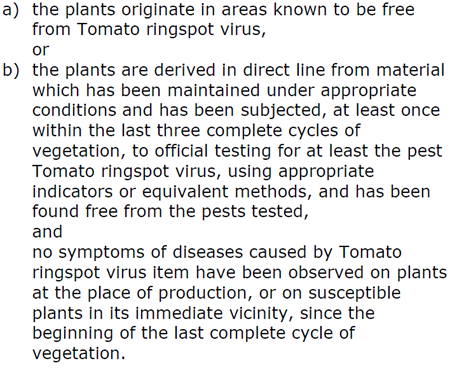
The Dutch National Plant Protection Organisation (NPPO) have recently made a formal approach to the UK’s NPPO with a proposal that retains the UK’s required levels of biosecurity but means NL would not be completely compliant with the AD until such time as a compliant testing regime can be in place (likely next year). The issue being that the requirement for official testing having been done at least once in the previous three complete cycles of vegetation cannot be met by the NPPO. The UK has agreed to this as a ‘bilateral arrangement’ with the Dutch as it does not compromise UK biosecurity & will still allow trade.
The Dutch proposals are based on :-
For Fruit trees
- Previous test results
- Testing of all root stock produced in a centralised facility
- Survey results demonstrating absence from the vector
Ornamentals
- Additional screening programme at places of production of stock destined for the UK
- A sample will be taken and tested at each place of production
- A separate sample will be taken for each genera
- The 5 largest lots destined for the UK will be selected for the sampling
All the above will be conducted by the Dutch NPPO, and the AD applied legitimately to the phytosanitary certificate. However, this means there will be some (significant) screening costs being incurred by Dutch exporters, which they may pass on to UK importers. The purpose of the screening is to demonstrate absence of the virus within the production process for stock destined for the UK.
This is a temporary approach based on the Dutch being able to demonstrate a type of equivalence until they can fully meet the testing requirements for individual lots.
Without this agreement, neither Prunus nor Malus would be able to be sent to the UK because the testing regime required is not in place, and there would be a risk of transmitting the virus through unclean stock.
The Belgian NPPO has made no such approach to the UK authorities, so full compliance with the AD must be adhered to in order for them to issue a phyto for export to the UK. Defra have said they (or any other exporting country) are welcome to contact them to discuss such an agreement.
Also, after some initial confusion, the HTA asked for and got clarification that neither P. laurocerasus (incl P. rotundifolia) or P. lusitanica are susceptible to ToRSV, so these particular species do not come under the ToRSV requirements and can be traded without application of this AD.
Plant Passporting clarification
You may have seen some information published this week stating that Allium porrum and Alliumcepa seeds were recently added to the list of seeds requiring a Plant Passport. As many of you will know, this requirement has been in place since 2021 and this was reported in error.
The Plant Passporting gov.uk page detailing what plants & plant products come under plant passporting requirements has indeed been updated recently (9/9/24) with a new more detailed list of wood products and wood needing a passport, but the actual requirements have not changed for anything.
A reminder on “no-matches” when importing and non-compliance issues
It’s really important that everyone knows the correct procedures and information to use to make declarations and prenotifications when importing plants. It is especially important now to get all the information to match between all the systems, and to make sure declarations correctly represent the goods you are importing, including when importing CITES species. Due to recent system changes, both the customs and IPAFFS systems will be cross-checking a lot more of the information shared between them, particularly bulbs and many plants for planting consignments.
Please encourage suppliers, service providers and agents to check and double check everything is imported (and exported) with the utmost attention to detail. While HTA acknowledge that the border system often does fall short of expectations, there remains no reason not to make our best endeavours with regards to compliance, as we know so many of you do.
It has come to our attention that authorities are cracking down on the current level of misuse of both the declaration systems and the CITES systems. Thye have highlighted to us that that have been goods mis-declared and that also some consignments are not reporting for checks at Sevington when called in. HTA obviously do not condone this sort of activity, and caution that if our sector is found to be operating outside legal requirements, then stricter penalties are to be expected along with the loss of the excellent sectoral reputation for compliance we currently enjoy.
If you have any issues at all, or come across any non-compliant consignments, please contact the HTA Trade Policy team on [email protected] for advice and assistance.
Defra will start issuing the invoices for the Common User Charge from Monday the 5th August. This will be for three months’ worth of imports using the Short Straits (Dover / Folkestone) routes and Eurotunnel i.e. everything that should have had a check at Sevington BCP – even if it hasn’t received one. The payment will be due by 4th September, so within 30 days – (despite the charges covering a period of 90 days). The invoice will be sent to the importer identified on each IPAFFS prenotification (or their agent).
Please note – an agent may well charge an extra admin fee for handling the invoice / payment. Please speak with them to ascertain if this will be the case.
HTA Policy Team have a meeting with Defra’s CUC team next Thursday 8 August, if you have any questions you wish answered, please send them to [email protected], join Defra’s CUC webinar on 13 August and/or come along to our next Policy “Borders & Trade” meeting on Thursday 29 August at 11am (please hold that in your diaries and email [email protected] if you wish to receive a link to the meeting)
CDS Downtime Scheduled
Due to scheduled maintenance on the Customs Declaration Service (CDS), the service will be unavailable to all users on Saturday 6th July 2024, 9:30pm to 5:30am Sunday 7th July 2024. Declarations submitted during this timeframe will be processed at the end of the downtime. Creating, updating, or embarking a goods movement reference (GMR) that are linked to CDS could be affected during the times listed.
IPAFFS Fixes & Updates
It is anticipated that IPAFFS will be undergoing an update over the course of the 4th July. While this is not confirmed, please look out for a fix for the notifications (this should be turned back on), a new email notification for when consignments are released from holds and potentially the linking of commodity codes relating to bulbs (0601)
Immingham Port
HTA recently met with the port operator who runs the BCP at Immingham port (AB Ports). They are keen to learn more about how to handle plants efficiently and are looking for nurseries / distribution centres to visit with staff to see loading/unloading in operation at locations within a 1hr drive of their port locations of Hull & Immingham. Please email [email protected] if you would like to help out.
BCP fees & charges - update
We have updated our BCP costs and charges document with new information. Please feel free to share with your suppliers, hauliers and agents. You can also find the document here
IPAFFS Notifications
Last week an error occurred with the IPAFFS notification system, meaning that email & text notifications for CHED-PP applications had to be turned off. This means that you will not be notified if your consignment is held for inspection and will need to check IPAFFS manually to see if a consignment is on hold and may require a BCP inspection. This is expected to be fixed as soon as possible, but in the meantime please let everyone know who would normally receive a notification that notifications will not be automatically sent.
IPAFFS / CDS no-matches
IPAFFS and the Customs Declaration Service (CDS) currently cross-references the CHED-PP number generated in IPAFFS when you make a prenotification. This number must be copied & pasted into your customs declaration before submitting everything. If the number isn't in there, or it is different, then this will generate a ‘no match’ which will mean the consignment is automatically held for a documentary check. Please ensure your agents are aware this number must be duplicated in both systems exactly.
Commodity Codes
The Government plan to add in more links between CDS & IPAFFS to cross-match more Commodity Codes in the coming days. It is expected this will cover plants for planting and seeds CN codes. Currently only the CN code for seed & ware potatoes are cross-matched between IPAFFS and CDS. This will mean as plants for planting and seeds are added in it is vitally important that the codes match exactly between the two systems. Please make your agents aware that this will be happening within the next two weeks.
Minimum 4 Hour Prenotification Period Only for RoRo goods
It has been noted that some IPAFFS prenotifications are being made after the 4 hour notice period allowed has passed - for goods arriving by Roll On Roll Off ferry (RoRo). Notifications must be made 4 hours
before the goods arrive at the Port of Entry. This is an allowance for RoRo goods only, while all other goods must prenotify 24 hours before. The 4 hour RoRo allowance was introduced as an easement in 2021, so please do pre-notify before that period as we wouldn't want to lose the 4 hours period and have to revert to 24 hours notice.
Declare your trailer unit number and Vehicle Registration Number (VRN)
When pre-notifying on IPAFFS, it’s important to add the trailer unit number, and where applicable/possible the Vehicle Registration Number (VRN).
For accompanied loads trailer unit number should be provided and where possible the VRN
For unaccompanied loads trailer unit number should be provided. Unaccompanied loads will also need to add the trailer number in the Commodity Additional Details section.
This can be declared on the ‘Transport to the Border Control Post (BCP)’ tab in IPAFFS and should be provided in the ‘Transport identification’ field, as seen in the screen shot below:
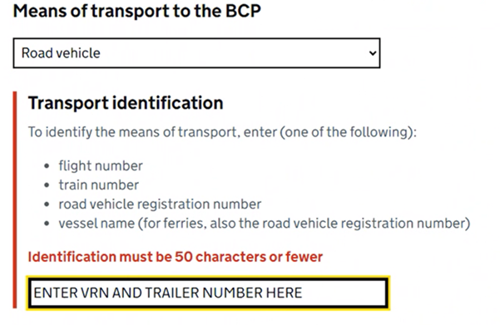
You will need to amend the notification as soon as you have this information and when the CHED status is NEW. You will not be able to amend the CHED when the status is IN PROGRESS or VALID.
This means APHA will be able to identify consignments through the port operator’s systems. If the information isn’t available when the notification is submitted, you will need to amend the notification when it becomes available. Also encourage hauliers /agents to make the same information available on CNS or Destin8 (third party systems for vehicle movements). Without the reg or trailer number, the consignment is highly likely to be delayed while APHA work with the notifier to identify the consignment.
What comes first - CDS or IPAFFS?
After completing your prenotification for your import, the IPAFFS system will provide the information you need to begin your customs application. It is important to match what you declare on IPAFFS with your customs declaration, or you will experience delays as Defra & HMRC.
Top Tips
- You can find your unique customs declaration reference on the ‘Review Your Notification’ at the end of your IPAFFS pre-notification. You can copy this number and use it to begin your Customs Declaration.
- Matching between your IPAFFS and customs declaration occurs through a system called ALVS, along the following three data points, which you must make sure are the same on both applications.
- Commodity Code of declared commodity
- Net Weight of each declared commodity line
- Customs Declaration Reference
Still stuck?
If you require help with filling in your IPAFFS notification, please get in touch with us on [email protected]. Please include screenshots,
From 30 April any urgent BTOM/import queries for plants and plant products across England & Wales should be directed to the Animal & Plant Health Agency (APHA), by email, in the first instance: [email protected]
Alternatively, you can contact them by telephone: +44 (0) 3000 200 301
Animal Products
Any urgent BTOM/import queries for animal products should be directed to the Port Health Authority (PHA) at your nominated Border Control Post (BCP). Find your PHA contact details at your nominated BCP on this map.
Remote and code locked containers
To ensure that physical and identity checks can be carried out on consignments at a BCP, it is important that the staff at the facility are able to access the contents of the container. Some containers are remotely locked or need a code to access. In these instances, businesses need to be available at the time of arrival to provide the BCP staff with an unlock code to access the contents, this will likely be a phone call from BCP staff or Driver. These codes can also be supplied via IPAFFS to speed the process up. The codes will be handled sensitively and not shared other than for the purposes of unlocking the container. Seals should remain in place as these will be checked and broken by APHA/PHA staff where necessary.
Use the right commodity codes for IPAFFS and CDS
You or your customs agent must make sure that the commodity codes declared in the customs declaration are the same as the commodity codes declared in your import notification on IPAFFS. You can amend these codes to ensure that they match, but you must do this in both systems. Failure to do this is likely to result in your goods being called into a BCP and held until the error corrected.
Getting the destination right on the CHED
There can only be one Place of Destination named in the CHED import notification. The Place of Destination named in the CHED import notification should be the place of unloading once the consignment has entered Great Britain.
If there is no single place of unloading – each consignment in the load has a separate destination and the driver is going to multiple unloading points - each consignment in the load should have a separate CHED import notification.
Also, ensure the separate country box for delivery address is the UK, not the country of origin of the plants / goods.
Make sure your CHED is completed accurately and fully
You must make sure that any errors in the CHED import notification are corrected before the notification is submitted, this includes ensuring that all information is completed and accurate. IPAFFS will give you a list of errors to work through. You must also make sure that the notification is submitted by clicking the green Submit button after you have reviewed it.
On the Dashboard, check that the CHED status is NEW. If the CHED status is DRAFT, it has not been submitted.
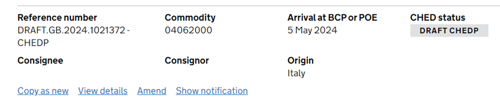
Click Amend and then in the CHED Notification Hub, click on Review and Submit and complete the submission process.
Once it has been submitted, use the Show Notification button on the Dashboard and then your browsers Print function to create a PDF of the notification. Send the PDF to the haulage company to share with the driver.
IPAFFS notifications
Please note – IPAFFS will send an email / SMS to the pre-notifier and all the nominated contacts if a CHEDD-PP (consignment) is selected for inspection when the prenotification is made. It will also send an email if the status of the prenotification turns from ‘no hold’ to ‘inspection required’.
However, if the CHED-PP is then released (changed to ‘VALID’) no notification will be sent. This means that hauliers (or anyone else on the contact list for the prenotification) will not be automatically notified that the load is released.
The pre-notifier who makes the notification needs to check often if the status of the CHED-PP has changed to see if goods are released, and ensuring hauliers are aware when the consignment is available post-inspection.
Responsibilities
A reminder that ultimately the importer is responsible for consignments of goods and is responsible for ensuring all legal obligations are discharged – including ensuring loads report for any checks that are called for by the Government Department or Agency making them and also that CITES documentation is correct.
Importers are defined as the entity making the international trade (placing the order with an exporting supplier in another country and who will receive the goods on entry to the UK), so even though you may employ an agent to do the paperwork and a haulier does the transportation on your behalf- if you are buying from abroad, you are ultimately the importer.
Please check agents know that CITES import permits must be applied for CITES goods (some cacti, some orchids, carnivorous plants, aloe, etc) More information on CITES on the Plant Health Portal.
This means that ultimately the agent is not responsible nor the haulier for ensuring checks happen, (even though they may have Delegation of Authority to act on your behalf) - the importing business is still responsible. So, if any checks are called for, then you must make sure that this happens as non-compliance will be registered and ultimately there will be consequences.
When you raise a notification in IPAFFS, you are responsible for the consignment from when it enters Great Britain until the authorities complete their checks
Arrivals at Sevington BCP
If your consignment is selected for inspection at Sevington BCP please inform the haulier. The driver will need to have the GMR number with him and also the CHED-PP number(s) of the consignments selected for inspection – this means that inspection will be faster and go more smoothly.
Please note – on arrival at the Sevington entrance booths, the driver should say they are there for a Defra inspection. Otherwise, the lorry may be sent to the Customs / HMRC / Border Force facility which will significantly delay the lorry, as it will need to clear that facility and re-enter the site again.
The driver will be given paperwork that says “Defra” on the top. If this doesn’t happen, please ask the driver to query this.
BCP operations & Port User Fees
We have summarised the fees & invoicing procedures of the main BCPs used by plants, seeds and bulbs for import into GB. The document can be downloaded here
Destruction of Plants at BCPs & Olive trees
While we still await more details from every BCP operator on costs and processes for destruction, we can advise that any plants not labelled may be treated as ‘unknown’ so please, unless it is absolutely obvious that a batch or bundle of plants is the same variety, ensure plants are labelled correctly with the name used to prenotify it. This will avoid delays and potential destruction orders.
In addition, we have been informed that inspectors are seeing Olives being imported without the required tamper-proof labels. Please ensure your supplier is attaching the required tamper-proof labels, and the olives are fully compliant with the current requirements. As olive is a high-risk Xylella host, plants without the required documentation & label will be removed and destroyed. The requirements are set out here
Plant Imports - Threats Hierarchy Updated
HTA recently made available a “Plant Risk Hierarchy” document that Defra had compiled, detailing the plants most likely to attract an import inspection, along with their associated pests and reasons for inclusion. Defra have now updated that document (now called the Plant Import Threats Hierarchy). It can be accessed on the Plant Health Portal, or we have produced a pdf that you can download and share with your suppliers and hauliers, in order to aid loading prior to import and so you can manage your import risks accordingly.
The Import Threats Hierarchy provides high-level information on threats associated with particular commodity groups, based on information including, but not limited to, the UK Plant Health Risk Register. The hierarchy does not replace BTOM categorisations but complements this and other available information, to provide a high-level overview of import threats. The hierarchy is regularly reviewed.
APHA inspection charges & who is invoiced
There has been some confusion over the application of plant health import inspection fees following the move to IPAFFS from PEACH recently. Some agents are asking why they can't nominate their customers (importers) when they make an import prenotification. We can confirm that as long as the agent has set up Delegation of Authority (DoA) to allow them to make a CHED on behalf of another business, then IPAFFS will allow the agent to nominate, and charge, the importer (i.e. the agent's customer) rather than the agent. However, if an agent has made an application for an importer directly, without a DoA, then the system will assume that agent is the important and they will be charged and liable for the fees. NOTE this information refers to APHA import inspection fees, not commercial port's BCP port user fees, or the Common User Charge applied at Sevington. These are separate charges and conversations with agents, hauliers and suppliers should had determining who will be liable for the port user fees/CUC.
Guidance for multidrop deliveries after 30 April
Defra has prepared some guidance for the businesses operating multi-drop deliveries under the POD scheme and how this is applied after 30 April 2024. The guidance helps determine what a phyto covers, and how plant passporting can be applied when a consignment is imported for multiple delivery address, under one importer, e.g. a multi-site business or several stores.
BCP Designations, Opening Hours and Port User Fees
At our last webinar on 15 April, we said we would pull together a list of BCPs, their opening hours and where the relevant port user fees could be found. We are still working on this information, however, at the time of writing, Felixstowe and Harwich have published their fees. However, neither CldN Ports Ltd (Killingholme) or Associated British Ports (Immingham and Hukk) have published theirs. We are assured these will be issued shortly and will let you know as soon as we have it.
HTA Statement on BCP Checks & Rumours of Delays
You may have seen press articles and heard rumours claiming that checks at Border Control Posts (BCPs) will be delayed, and will not start on the 30 April.
This is not the case. The Place Of Destination (POD) will cease and checks will instead be done at BCPs from 00:01 as of 30th of April.
As we, and Defra officials, have explained on our recent webinars, Defra and APHA will be taking a pragmatic approach from the 30 April to BCP checks.
While HTA still advocate for a dual POD & BCP system, this means that inspections will commence at BCPs on the 30th of April, however, APHA will not be inspecting everything from Day 1. Rates of inspection will be increased over a period of time in order to minimise disruption, ensure learnings are made, systems work, processes are tweaked and the flow of goods through ports made as smooth as possible.
To be clear – from 30 April you will still need to pre-notify your goods on IPAFFS, selecting a BCP instead of your POD. PODs will not be available to select on the system. If selected for inspection (placed on hold) the consignment must report to the nominated BCP for its check. A reminder to keep checking IPAFFS as goods may well be released by inspectors if consignments build up.
HTA will seek further clarity on how the pragmatic approach will operate, and we continue to express our concerns that the shift to BCPs creates uncertainty and extra costs that are difficult to forecast.
We will continue to keep you up to date as inspections are dialled up, providing you with advice, events and answering your questions. We update our advice & news ‘snippets’ page regularly, so please do check back for updates regularly.
If you have any questions or comments, please email [email protected].
Further information also on the Defra blog: https://deframedia.blog.gov.uk/2024/04/19/coverage-about-upcoming-border-checks/
Town Hall recording and slides
On Monday 15 April, the HTA held the second in a three-part series of virtual sessions on Border Controls. You can view the recording and slides here.
CUC Billing and Invoicing Guidance
Defra has updated the Common User Charge guidance to include billing & invoicing information on how the charge will be applied and how invoicing will work.
Undesignated BCPs removed from IPAFFS
There will be a number of Border Control Posts removed from IPAFFS before 30 April that will no longer handle plants. You can find out which BCPs are designated to handle plants here and a list of those pending designation here.
Border Control Points designation list
The Government has finally released details of the Border Control Points still to be designated in advance of the 30 April 2024. There are several commonly utilised routes for plant material coming into the UK have BCPs pending designation on the list, including Sevington and Killingholme. These are expected to be successfully approved before the 30th.
There will also be a list of Control Points pending designation available, but this is yet to be published. The map of BCP & CPs already designated can be accessed here which is where we expect to see the pending CPs listed too.
Defra Readiness Survey
Defra wants to hear how ready traders are for border checks from 30 April. Use this survey link below to tell them how ready you are for 30 April. It will take a few minutes to answer the survey and you’ll be directed to latest guidance on new import controls at the end.
Borders Webinar 28 March - recording and papers
On Thursday 28th March HTA held the first in a series of three webinars looking in more detail at the border control changes coming in on the 30th April 2024. You can view the recording and slides here
The next session will be on the 15th April 14.00, please register here to attend.
IPAFFS update – Commodity Code upload fixes
There have been multiple errors in IPAFFS recently, with expected fixes not working, or new errors cropping up, particularly with the Commodity Code 06029050, which hasn't worked at all and is one of the most used codes in the trade.
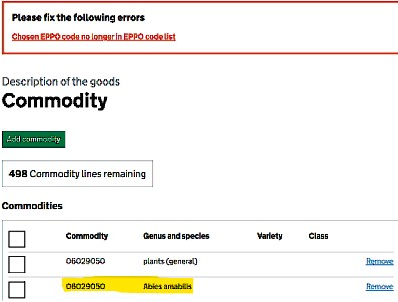
- Defra have confirmed that 2 fixes have been pushed through and synced with IPAFFS over the weekend: 06029050 EPPO XXXXX – The sync has been successful, and trade now have the option to select this code when the commodity code they are trying to import does not exist in IPAFFS. This is meant to be an interim fix until we have a full complement of commodity codes uploaded. Allowing them to continue with the CHEDPP.
- 20K+ lines of commodity codes - this is a further update of more EPPO codes (commodity) with a larger selection for Trade to choose. This fix is broken into 2 parts –
- Sync 20K+ lines into IPAFFS which makes them visible but not selectable in a CHED
- Release into the live IPAFFS environment which will make them selectable in IPAFFS to create a CHEDPP.
The first fix (XXXXX) has been tested and completed and is now live in IPAFFS (Image 1) which provides trade the opportunity to continue to USE IPAFFS.
The second fix (20K+ lines) - only the part A of this fix is complete, and we are expecting part B to be complete in the coming days. At this point in time, we do not have a date when part B will be uploaded; when we do have a specific date, will be shared that with you.
What this means to trade:
- Traders will be able to select the XXXXX EPPO code in IPAFFS (This has been tested and confirm it works in IMAGE 1) when traders are unable to locate the specific EPPO code they would like to import. This is a temporary measure until the 20K+ lines are uploaded to IPAFFS allowing trade to continue to use IPAFFS.
- The 20K+ lines are visible in IPAFFS (Part A) unfortunately at this current time they may not be able to select them for importing (Part B) and will get an error, as shown in the below image (image 2). We are waiting for IT to upload this into IPAFFS for these codes to be selectable and we will advise as soon as this update is complete. In this incidence – trade should use the XXXXX code.
We are continually working with IT to achieve a full listing of Commodity codes/EPPO codes and will continue to keep trade updated as this continues. This new way of working will allow the IT Plants team to be proactive in tracking updates/changes and advise trade accordingly. Please be assured the Defra IT Plants team are doing everything possible to get the system where is needs to be as quickly as possible.
Image 1
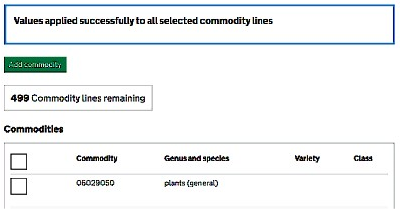
Image 2
Common User Charge (CUC)
The Government has this morning released details on the Common User Charge (CUC), which will be levied on all eligible consignments entering GB via the short straits route.
The CUC is a BCP user charge that will be applied to consignments that might need to receive an inspection at Sevington BCP – which is Government run - and have entered GB through the port of Dover and Eurotunnel.
The charge that will be levied on each eligible consignment will be £29 per commodity line - i.e. each line added to an IPAFFS pre-notification.
This will be capped per IPAFFS pre-notification (per CHED) at 5 commodity lines, regardless of how many lines are included on the pre-notification. Therefore, the cost will be capped at £145 per consignment (CHEDD-PP).
Eligible Consignments
An eligible consignment is a consignment which requires an inspection for SPS (sanitary phytosanitary) purposes and is categorised as high or medium risk.
These would include those containing plants, cuttings, seedlings, bulbs, some seeds, some cut flowers, cut Christmas trees, potato tubers, used agricultural & forestry machinery and some fruit & veg.
The CUC only applies to Government run BCPs (i.e. Sevington) and does not apply to transit movements of high & medium risk plants & plant products.
AOS Pilot participants will not pay the CUC, as long as checks are made at a CP.
Invoicing
The charges will apply from 30 April 2024, and will be invoiced to the organisation making the pre-notification on IPAFFS.
There will be an option to indicate who to invoice in IPAFFS.
Invoicing will not commence until 3 months after the 30th April, and then be made on a monthly basis in arrears.
The CUC will be reviewed regularly by Government, initially monthly, and in particular the impacts on groupage & SMEs will be monitored by DEFRA in conjunction with the Department for Business & Trade.
There will be a full review in 12 months’ time.
More Information
More information can be found here – although the full detail and guidance is yet to be released, including compliance procedures.
There will be a helpdesk set up to answer queries.
A Defra webinar has been set up for the 10th April. You can register here.
We are planning to run our own webinar in the coming days with Government officials attending who will answer your queries. We will keep you up to date with this via Member Update.
The plant health inspection import fees (post 30/4/2024) can be viewed here, and the current import inspection rates can be viewed here.
Our Press Release on the CUC can be found below; you can also access it on our website.
Arrangements at Other BCPs
Different charges, using different methods of invoicing, will be used at privately run BCPs e.g. Harwich. Harwich’s charging structure can be viewed here (2024 Harwich International Port Tariff, Physical Examinations section 3.1, page 9). Harwich will charge only when a consignment is inspected at the BCP, and the charges will be dependent on a number of different factors, e.g. palletised, temperature controlled, accompanied, partly unloaded, etc. The charges will be invoiced to the declarant identified by the carrier (e.g. Stena Line) i.e. whoever makes the ferry booking. They will need an account with Harwich port for this. (For info: ‘palletised’ on the port tariff means anything easy / swift to unload e.g. Danish trolleys).
Other port operators are yet to release their fees for BCP users – we will bring these to you when released.
Questions for members:
- Please can you send to us a calculation of how much the CUC might cost you annually, based on the previous 12 months imports (even if you don’t currently use Sevington?)
- What might the impacts be on your business of the CUC?
- Might the introduction of the CUC at Sevington change the route by which you would normally bring your imports into the country? Why?
- Will this news now influence your business decision on whether or not to make an application to become a Control Point?
- What further detail do you need to bring surety to your cost forecasting post 30/4/24?
- What questions do you have on the CUC and port user fees in general?
Plant Risk Hierarchy
Defra have shared with HTA a Plant Risk Hierarchy. This indicates which species of plants are most risky, within the high risk category, and therefore what APHA are more likely to target for inspection purposes. One of the issues with received a ‘hold’ notification on IPAFFS is that you don't actually know what APHA are looking for in that consignment, which might consist of many species of plants.
Practical Considerations for Importers after 30/4/2024
Following several visits to BCPs, talking with port operators & stevedores and also with APHA inspectors, we have compiled a list of practical considerations and actions you might take to help make the process of import inspections smoother on 30 April and after.
Fees for Plant Health Import Inspections in England and Wales from 30 April 2024
You may have seen an ‘updated plant health inspection fee’ schedule being circulated. The inspection fees are not changing for plant health inspections for plants for planting, bulbs or seeds sourced from the EU – these will remain as they are. The new table shows the fees for inspections on medium risk goods from the EU which will come into scope for checks from 30 April 2024. Medium risk includes some species of cut flowers and some seeds. The fees which are applicable from 30 April 2024 are shown on the Plant Health Portal.
HTA Summary of Borders Issues & Asks
The HTA have prepared a 1-page summary for sharing widely which is available here: https://hta.org.uk/policy/policy-member-briefings
IPAFFS / CDS Link after 30/4 (HMRC and Defra services will be linked)
While IPAFFS and CDS are separate digital services there will be a background process that validates the import notification reference, checks the commodity code/s and net weight/s for the consignment and provides the SPS inspection decision for the import notification to CDS. This means that if the two do not match up before the goods arrive at the UK border, then this will trigger a ‘No Match’ error within a few minutes of submitting the customs declaration. If this is not fixed before the consignment reaches the port, the consignment will be directed to the Border Control Post when it reaches GB. This will mean it will join the other consignments waiting for a physical inspection, delaying the consignment / lorry.
“Get Ready for 30th April” - HTA Online Events
With just 7 weeks to go before the 30th April, we are planning a series of Member Advice webinars in the run up to the change from PODs to BCPs. At the events, we will give you the latest information on what to expect after the 30th , how to plan & prepare as best you can and also will invite external speakers, such as Defra & APHA officials, to present the latest.
We will be setting up online registration for the events below on our website in the coming week, but in the meantime please hold the dates in your diaries. Each one will start at 2pm.
25 March - "Border Controls: Get Ready for 30th April Part 1"
15 April - “Border Controls: Get Ready for 30th April Part 2"
29 April - "General Policy Surgery" (to include borders, peat)
We are also planning an ‘open to all’ CITES online webinar for early May, so please look out for that too.
If you would like to pre-register for any of the above webinars, please email [email protected]
Government testing starts
Over the next few weeks, HTA are involved in helping the Government’s Cabinet Office plan, conduct and evaluate ‘end-to-end' testing for imports containing plants. This particular testing is looking specifically at how all the systems that will be employed interact with each other and identify any pinch points in the export/import process. The tests will be designed to challenge the system and be as complex as possible. Other testing currently being planned by Defra, and in which the HTA is also involved, will include Harwich and Killingholme BCPs as well as Sevington, and will test all aspects of plants and plant product importing.
Defra Webinars on April border changes
Defra have released a series of free webinars explaining what preparations can be made in advance of the border control changes coming in on 30 April 2024. There are 2 already added to the series looking at changes affecting imports for the plants sector, one on the 14 March at 10am, the other on the 11 April at 11am.
IPAFFS News
We remind everyone that PEACH will close completely on 8 April, meaning all import prenotifications will need to be made on IPAFFS. Currently the conversion rate of businesses moving from PEACH to IPAFFS is very low, and we would recommend that you start your IPAFFS prenotifications well in advance of 8 April, in order to ensure you are fully conversant with the system. If an agent makes prenotifications on your behalf, please check in with them that they have moved to IPAFFS. Registering is a very simple process, and there are plenty of training webinars to attend.
e-Phyto
We are interested in hearing yours or your agents' experiences with ability now to attach electronic phytosanitary certificates to pre-notifications from the Netherlands. Please contact [email protected] with any experiences, good or bad, so that we can formulate a casebook to go back to Defra with.
Common User Charge (CUC) news
The Government are yet to announce their plans for the CUC, including its method of charging. We are aware of rumours that the charge will be made per commodity line, or commodity code. While we have no news on whether this will be the case, we have been presenting evidence to Government officials, speaking with Ministers and MPs and working very hard in the background to ensure that the CUC is applied fairly and without over-recovery of costs at Government run BCPs at the expense of the plant sector. We are also aware that privately run / commercial BCP operators are yet to formally announce their own charges & methodologies, so we have been evidencing the potential impacts of this too. If you have any comments or evidence on potential business impacts to submit, please email [email protected]

Important Documentation
HTA have updated the BCP Costs & Operations information document to include Port of Tyne and additional contact details for other BCP operators, plus some tips on how best to use Sevington if called there.
Document is accurate as of the 14 August 2024
Policy Team
Should you have any questions or additional concerns, please do not hesitate to contact our Policy and Public Affairs team.